





26 Jan Pain and acupuncture
By Juan Hahn

Pain is one of the most frequent reasons for acupuncture consultation. Pain, especially chronic pain (i.e., lasting longer than three months), entails a significant problem with very important familiar, labor, and socioeconomic implications, which also significantly worsens the sufferer´s quality of life.
Acupuncture points have unique neurovascular, histological, and bioelectrical properties that make them different from the rest of skin. These points relate to internal organs (somatovisceral relationships) and vice versa (viscerasomatic relationships). Over thousands of years, the Chinese (as well as other peoples, and not only Asian communities) inferred from observation that it was possible to relieve pain and to treat internal organ problems by stimulating these points.
In 1979, acupuncture was officially recognized by the World Health Organization (WHO) as an effective therapy for numerous pathologies, one of which being the treatment of pain. Likewise, more than 16,000 published scientific articles support the effectiveness of this millenary method.
There are big unknowns about the mechanisms involved in pain and its relief, both from a Western biomedical point of view and from a Traditional Chinese Medicine or TCM approach.
In this blog, I try to explain what pain is, its classification, how it originates and transmits to the brain, and what happens when we turn to acupuncture to treat pain, emphasizing the biochemical and neurophysiological aspects more than the biophysical ones, where existing unknowns are even greater, and which we should approach from biomagnetism, chaos physics, epigenetics, and quantum theory perspectives.
Pain is a very broad term encompassing unpleasant experiences of sensory or emotional origin associated with actual or potential damages. Pain transmission is determined by excitatory and inhibitory systems, and pain magnitude is established according to number of impulses. Impulse intensity will always be the same due to the all-or-none law of action potentials, but what will determine the pain magnitude will be the number of impulses, that is: the greater number of impulses, the more pain; the lesser number of impulses, the less pain.

Free nerve endings called NOCICEPTORS innervate all over the body, including skin, muscles, tendons, ligaments, bones, and viscera, and they transmit that information to the spinal cord. When pain comes from the area where nociceptors locate tissue damage, we call it “nociceptive pain.”
If pain is due to a nervous system injury, or there is an alteration of nociceptive information transmission at central or peripheral level, we call it “neuropathic pain.” Clinical characteristics of this type of pain are hyperalgesia (generally painful stimuli are even more painful) and allodynia (normally painless stimuli are painful).
If pain originates outside the central nervous system (CNS), for instance, in the legs or arms, hands or feet, we call it “peripheral pain.” Finally, when pain in the CNS (spinal injuries, CNS tumors or chronic pain) is called “central pain.”
When tissue damage occurs, local inflammatory mediators such as IL-1 and TNF-alpha cytokines, which act on endothelial cells favoring leukocytes migration, are released and activated. Mast cells (a class of cells belonging to the immune system) secrete vasoactive agents such as serotonin and histamine, while the macrophages –together with mast cells– release mediators inducing vasodilatation and are responsible for edema formation.
Additionally, lipid mediators such as prostaglandins, leukotrienes and tromboxanes, as well as arachidonic acid derivatives such as cyclooxygenases and lipoxygenases, are released. Among neuropeptides secreted by sensory nerves and leukocytes, we find substance P and neurokinin A, which serve to transmit pain signals, regulate blood pressure, increase vascular permeability and activate endocrine cells secretion.
Some of these biochemical substances result in an excitatory effect on nociceptors, whereas others have an inhibitory one. Once generated, this signal is conveyed to the spinal cord through some nervous system fibers. Most of these afferent fibers (i.e. when its pathway runs from the peripheral nervous system or PNS to the central nervous system or CNS) enter through the SPINAL CORD DORSAL HORN. This is where the connection (synapse) with another neuron (second neuron) takes place.
This is a very crucial point regarding pain transmission, since here, the Gate Control Theory comes into play. At this point, decussation occurs, that is, the action of transmitting an impulse to the opposite side to which it was generated, in addition to complex interactions between excitatory and inhibitory interneurons of descending tracts.
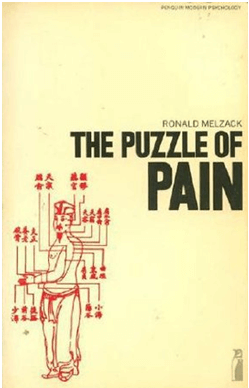
Gate control theory was proposed for the first time in 1965 by Mellzack and Wall.
There are several types of nerve fibers that transmit different signals from the PNS to the CNS. These are the key fibers related to pain:
– A-delta Fibers. Relatively thick diameter. Myelinated. Conduction Velocity: 20-30 m/s. Acute pain, localized.
– C Fibers. Small diameter. Non-myelinated. Conduction Velocity: 0.5-2 m/s. Chronic pain; diffuse.
– A-beta Fibers. Thick diameter. Myelinated. Conduction Velocity: 30-70 m/s. They transmit non-painful stimuli such as vibration or touch. Large diameter fibers.

The Gate Control Theory basically holds that there are two kinds of fibers involved in pain transmission: C Fibers and A-delta Fibers. There are also fibers that do not transmit pain but other sensations, such as touch or vibration. When arriving to the dorsal horn, only information from ONE of these fibers is allowed to pass through, “the one that got there first.” If the A-beta fiber is stimulated, it will send information to the dorsal horn with access priority for being “the fastest,” preventing the entry of impulses of C and A-delta fibers to the horn. This principle operates in much of electroacupuncture and Transcutaneous Electrical Nerve Stimulation (TENS).
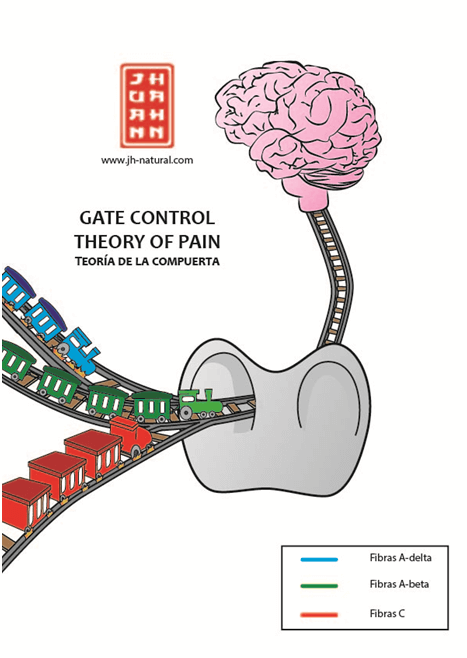
® Figure 1
Information is sent from the dorsal horn to higher CNS centers, activating the following different areas: on the one hand, those formed by cortical areas, including somatosensory regions, anterior cingulate cortex, prefrontal cortex, and brain insula; and on the other hand, subcortical structures, that is, thalamus, amygdala, hippocampus, and basal ganglia. All as a whole sets up the PAIN MATRIX.
There are modulation mechanisms in the thalamus able to control the amount of information transmitted from spinal cord. When information gets to higher CNS centers, endogenous regulation systems of this signal are set in motion (endogenous analgesia). One of these mechanisms is descending modulation pathways.
Two different types of pain can be distinguished according to pain duration:
ACUTE PAIN
It fulfills a protective function, responding to harmful stimuli that may cause organism damage. When an acute painful stimulus remains in time, it turns into chronic pain, and physiopathological changes complicating therapy occur.
CHRONIC PAIN
It does not fulfill a protective function. A loop is generated making pain perpetuate without an external causal agent.
The changes produced when pain stops being acute and becomes chronic are called sensitization. These changes are generated at peripheral level of spinal nerves, in spinal modulation and in supraspinal processing. In chronic pain, pronociceptive and proinflammatory substances that act pre- and postsynaptically are produced, thus establishing a feedback process.
One of the features associated with chronic pain is a painful sensation facing normally non-painful stimuli (allodynia). Likewise, another complication in this type of pain is that descending inhibitory pathways stop acting correctly, so the painful sensation increases even more. Consequently, we can consider two kinds of phenomena regarding chronic pain: perpetuation and amplification.

Acute pain has been ‘designed’ over thousands of years to help us to survive, warn us about tissue damage and, for instance, move your hand away from a pointed object or a flame, thus avoiding further damage.
However, let us imagine a savanna inhabitant from 150,000 years ago: a man with a swollen leg after a blow who is feeling a lot of pain. The first thing he will do is touch the wounded area, which is the oldest and most basic existing type of analgesia. When touching himself, he will activate the A-beta fibers (those transmitting touch but not pain) which will carry impulses much faster than A-delta and C fibers (those effectively conveying pain).
Because access to only one stimulus is allowed in the spinal dorsal horn, stimuli of fibers transmitting pain will be blocked (Gate Control Theory). This reflex action has been preserved to this day. When we hit ourselves with an object, the first thing any of us instinctively do is touch or rub the injured area. In essence, the expression “lick your wounds” has its origin in Gate Control Theory.
Now let us imagine that a lion suddenly appears. As mentioned before, the body is prepared to survive and therefore, after recognizing this situation, the brain will send a descending inhibitory stimulus to the dorsal horn making the pain go away, since it is now more important to fight or to escape than to worry about pain.
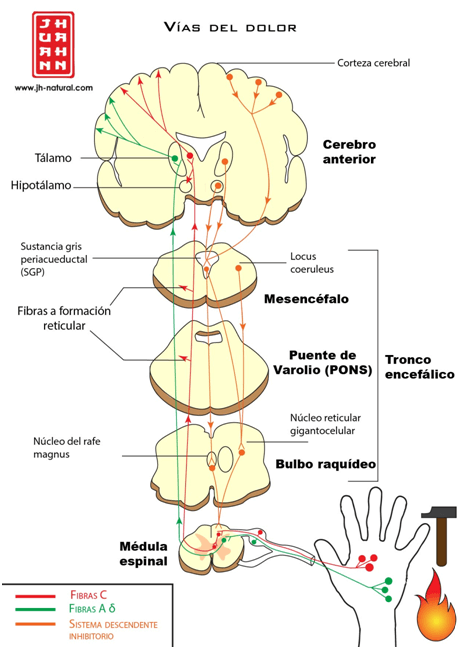
® Figure 2
There are numerous statements of soldiers on the battlefield or, for example, traffic accident victims who declare that initially, when their life was in danger, they felt no pain despite their serious injuries. The explanation for this kind of phenomena lies in the action of the descending pain inhibitory or modulatory system. If we consider that 12,000 years have been needed to change a genetic code, we can get an idea of the time required for mammals (specially, man) to develop this complex system.
MECHANISMS OF ACTION OF ACUPUNCTURE

We know that certain acupuncture points influence specific brain and spinal cord areas managing to release stimulating nervous system molecules, which are established through the personalized combination of therapy.
When an acupuncture needle is inserted, the different inflammation phases are triggered. Inflammation is a process developed by the human body in response to any type of aggression or injury. It starts with release of all sorts of mediators, which are mostly released by mast cells close to the affected area. Later on, vascular alterations and chemotactic effects favoring the transfer of immune cells and other involved molecules occur. The inflammatory process is an abnormal situation, so it should be reduced, resorting to the use of inhibitors and anti-inflammatories for that purpose.
There are three major groups of endorphins (endogenous analgesics): enkephalins, beta-endorphins and dynorphins. Analgesic acupuncture has a cumulative effect: when an opioid is released for a second time, the amount released is greater. Acupuncture treatment can stimulate enkephalin release in the dorsal horn.
Enkephalins are a type of endorphin that bind to opioid receptors and depress central nervous system neurons, thus blocking pain transmission. Likewise, additional neurotransmitters like serotonin and adrenalin are released in the dorsal horn. These neurotransmitters have a generalized depressor effect in the dorsal horn activity, and therefore they can modify and reduce pain transmission.
When depressing the dorsal horn activity, we influence afferent nerves, both somatic and visceral, since these two types come together in the same nervous tract.
The hypothalamus is one of the biggest beta-endorphin secretors. When the hypothalamus is stimulated, it releases beta-endorphins stimulating grey periaqueductal substance, thus depressing the pain signal sent from the periphery.
Serotonin is another neurotransmitter acting as a powerful component in control of the pain matrix. Serotonin is released in the brainstem, interacting in the descending pain inhibitory system. However, serotonin is not only released in the brainstem, but also together with noradrenalin in the dorsal horn. Both neurotransmitters effectively inhibit the pain transmission in both directions.
Ultimately, analgesic acupuncture acts at peripheral, spinal and supraspinal levels, using Gate Control Theory and the descending inhibitory system, among other resources.
PHOTO
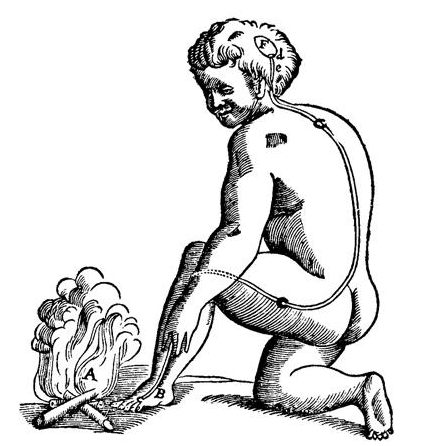
As early as 1664, Descartes already described the pain pathway in a very basic way.
® Text, Figure 1 and Figure 2 property of Juan Hahn
Sorry, the comment form is closed at this time.