




08 Jul Was acupuncture born in Europe? The man who emerged from the ice
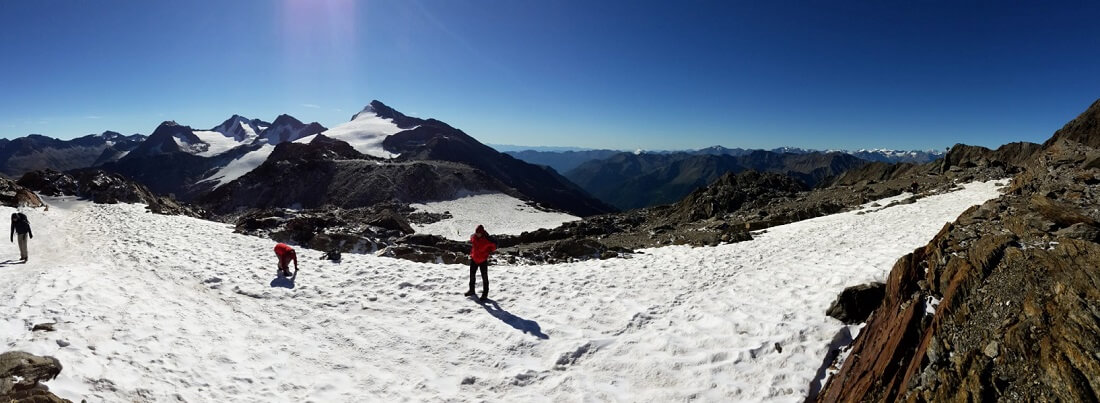
It was 1:30 p.m. on September 19, 1991, when a German couple discovered a body at an altitude of 3,210 meters in South Tyrol (Northern Italy), near the Austrian border. They alerted the authorities, and the police opened an investigation. At the time, nobody could have imagined that they were facing one of the most astonishing discoveries of the 20th century.
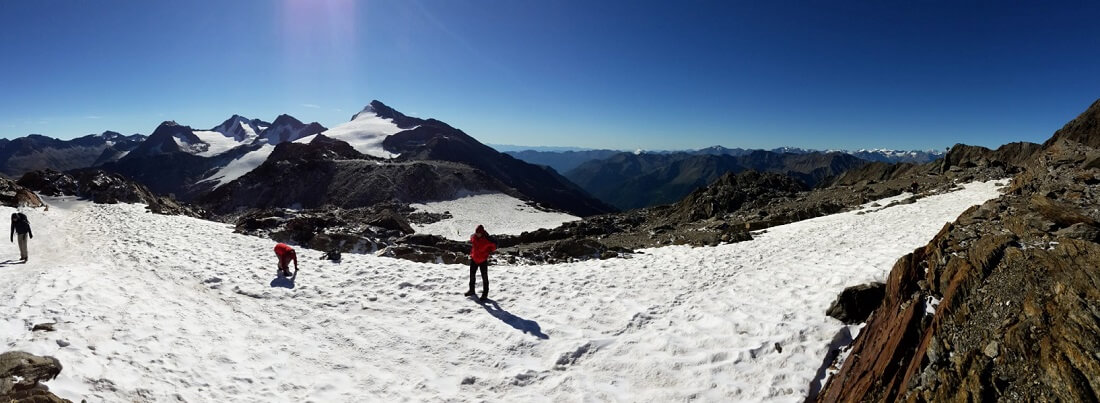
Fundstelle am Gletscher © Südtiroler Archäologiemuseum
Photo courtesy of the South Tyrolean Museum of Archeology
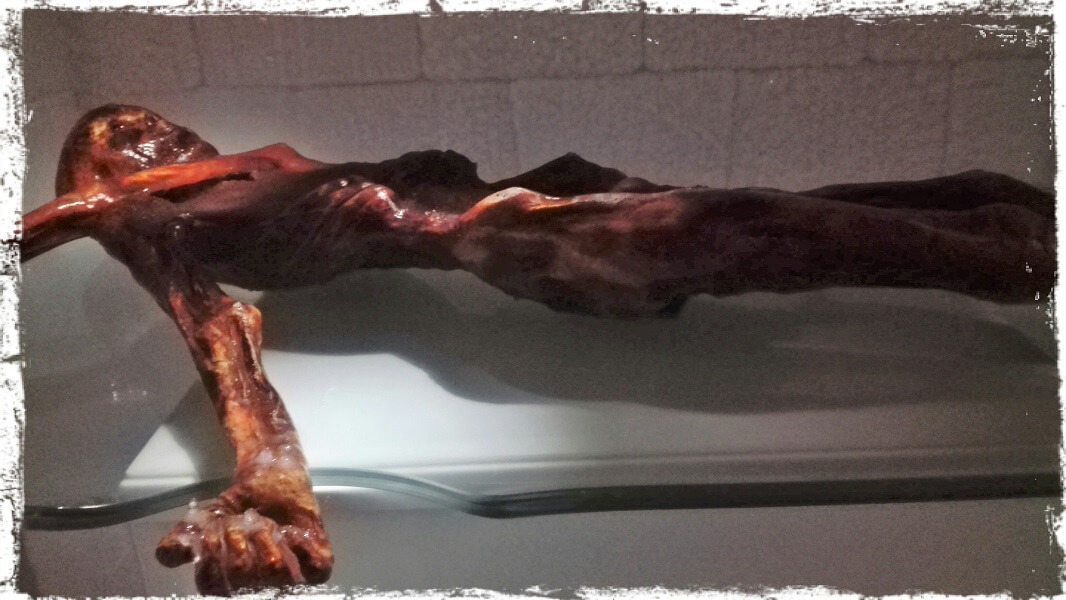
It was the mummified body of a male from the Neolithic period who died 5,300 years ago in that exact spot. It is currently considered the oldest mummy in Europe.
This is the story of Ötzi, also knows as “The Iceman”, named after Ötztal (Ötz Valley), the area in the Italian Alps where he was discovered. Global warming exposed this body, which had been covered by ice for more than 50 centuries.
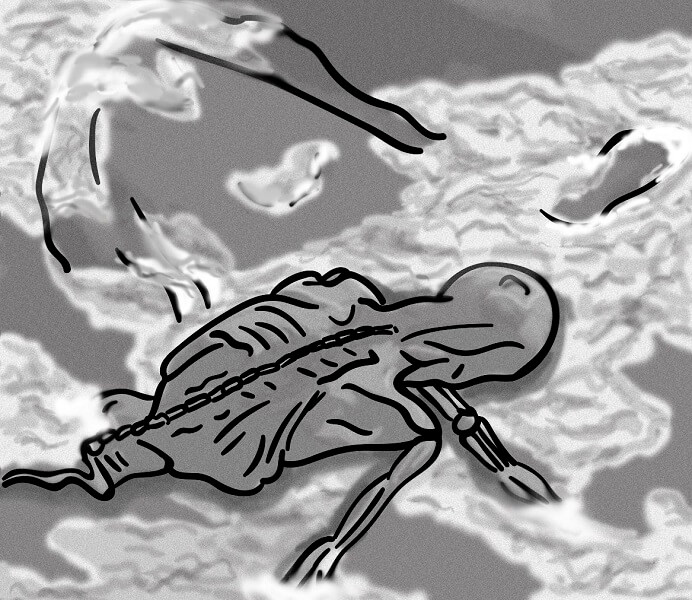
Position in which he was found in the ice floe
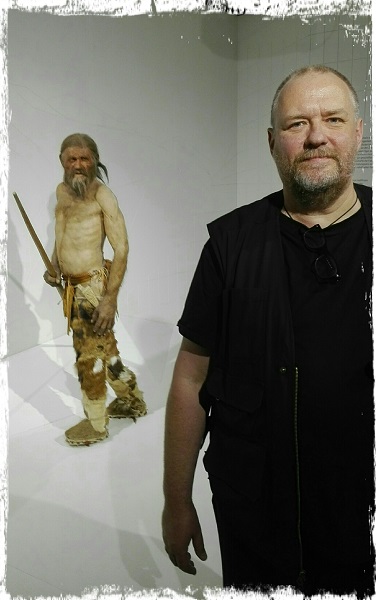
I was fascinated by this story for years. In May 2018, I participated in a seminar on YNSA (Yamamoto New Scalp Acupuncture) in northern Italy. It was a perfect opportunity to visit the South Tyrol Museum of Archaeology in the city of Bolzano. I saw Ötzi and all his belongings, and I was able to dive into all the circumstances surrounding the life and death of our ancestor.
When the body was discovered, it was extraordinarily well preserved. It had been covered first by a layer of snow, which allowed for natural ventilation and a dry environment. Over the years, the body was buried by glacial ice and preserved for thousands of years. Similarly, his clothes and belongings were maintained in exceptional condition. He bore a copper axe (the most significant find), a knife, a bow, arrows, a belt, a backpack, shoes, a hat, clothes, a “first-aid kit,” etc. The objects he was carrying were primarily wooden, made up of 18 different kinds of wood.
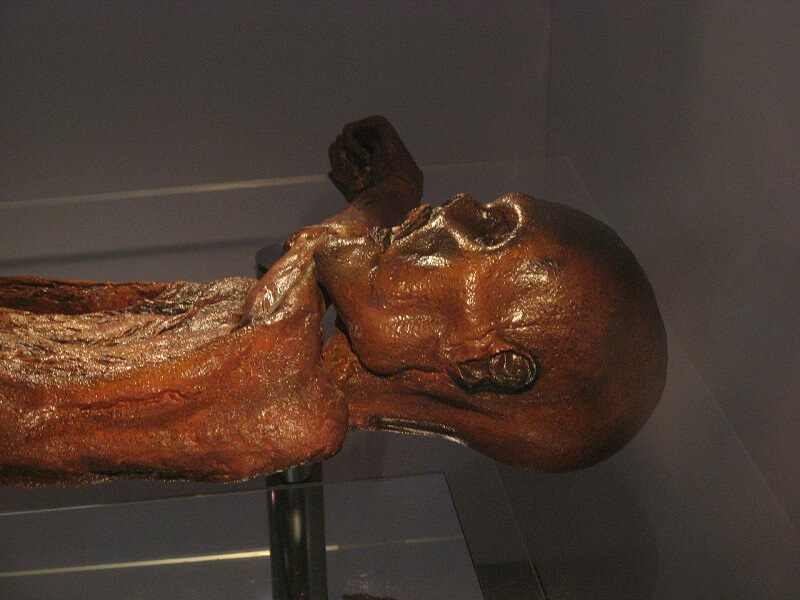
Ötzi was about 160 cm tall, a normal height for the Neolithic population. He would have weighed about 50 kg, and his feet would correspond today to a size 38. He died at about age 45. For that time, he would have been considered elderly, although he was in very good physical shape: muscular, without fat. Although he had cavities, he was not missing any teeth.
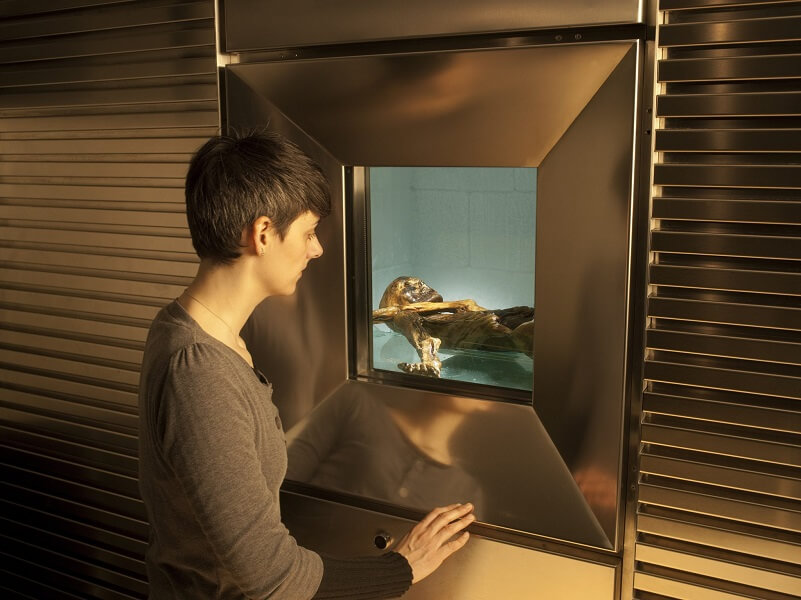
Vitrinenfenster zur Kühlzelle des Mannes aus dem Eis © Südtiroler Archäologiemuseum/Ochsenreiter
Photo courtesy of the South Tyrolean Museum of Archaeology.
Subsequent research has revealed that Ötzi was killed by an arrow to the back. Due to the pain it must have caused him, he likely pulled the arrow out, but the flint point remained lodged in his left shoulder. It had penetrated the reached the subclavian artery, a fatal wound (although not immediately so). He likely fell to the ground and hit his head. Some hypotheses hold that perhaps he was engaged in a fight with several individuals, based on the fact that there were different types of blood on his clothes. A few days before his death, he must have had another confrontation as well: he had an incised wound on his right hand. We will probably never know exactly what happened.
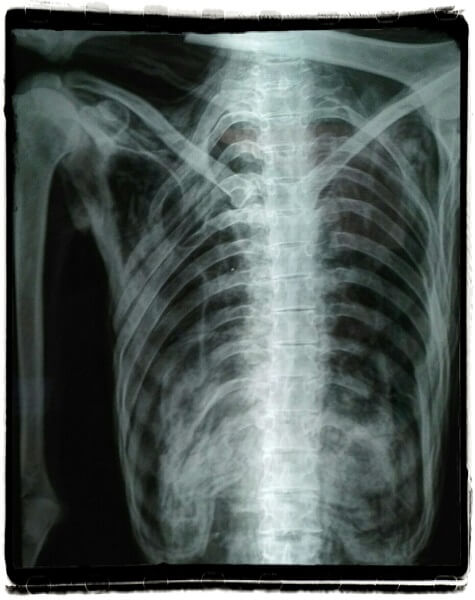
A thorough autopsy revealed that Ötzi suffered from trichuriasis, a disease caused by parasites called Trichuristrichiura or trichocephalus and transmitted by contaminated food, water, or soil. He also had Lyme disease, caused by the bacterium Borrelia Burgdorferi and transmitted by ticks. These conditions would have caused anemia and likely abdominal pain. He also had gallstones.
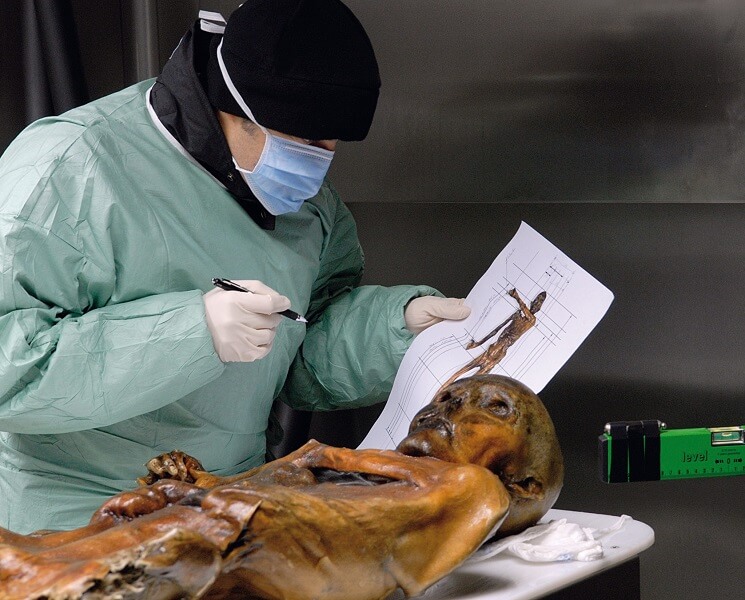
Untersuchung © Südtiroler Archäologiemuseum/EURAC/ Samadelli/Staschitz
Photo courtesy of the South Tyrolean Museum of Archaeology.
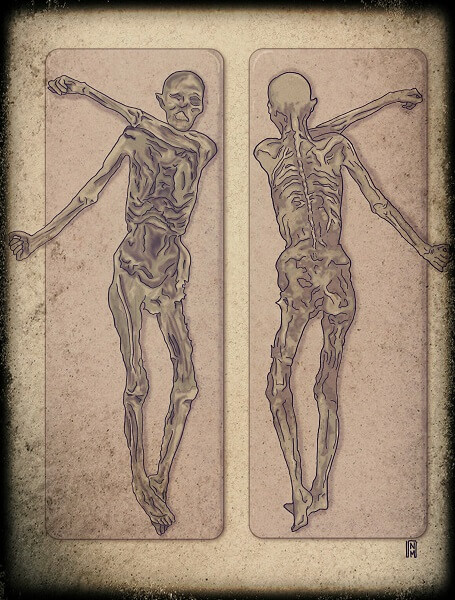
Radiological studies revealed that he had osteoarthritis in the hip, knees, ankles, and lumbar area. He was missing the twelfth pair of ribs, an anatomical variant that probably went unnoticed. Over the course of his life, he suffered several rib fractures and a nasal fracture, all of which healed well.
The arsenic content in his body was very high. He likely worked with iron or copper. However, his lead content was much lower than that of most people today. In addition, he was lactose intolerant.
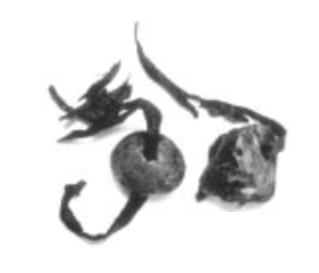
Ötzi carried what is the first documented medicine chest or first-aid kit in history. He had two globes, connected by a cord, of a fungus called Piptoporus betulinos, which contains purgative resins and oils with antibiotic properties. The fact that he carried this fungus with him indicates that he was aware of his illness and was treating it with what must have been the only pharmacological resource that existed in Europe at that time.
Ötzi’s stomach and intestines contained traces remains of charcoal, probably used to treat digestive problems. Even today, charcoal can be used to treat poisoning and viral diseases, thanks to its absorptive properties.
Ötzi had tattoos all over his body. It seems that they were not ornamental or aesthetic function, but rather therapeutic. They seemed to have been used to treat his digestive and musculoskeletal ailments. These tattoos were made by small cuts, not needles. These 61 marks are the oldest tattoos on record, as reflected in the Guinness Book of Records. In 2014, multispectral imaging allowed us to identify these 61 tattoos and the 19 groups in which they were sorted.
A large number of these tattoos, made mostly with soot and ash, coincide with almost millimetric precision with acupuncture points. Thus, they would have been quite an effective analgesic. Most incredibly, these points, when studied holistically, correspond to a modern acupuncture treatment for osteomuscular pain and digestive discomfort.
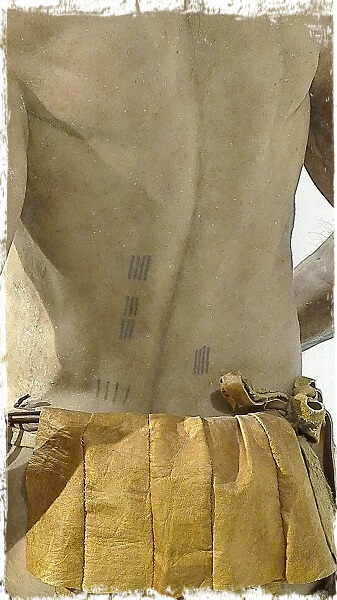
Tattoos on his back
The documented acupuncture points are:
– Bladder 21, Bladder 22, Bladder 23, Bladder 24, Bladder 25, Bladder 56, Bladder 59, Bladder 60,
– Liver 5, Liver 8, Liver 14, Liver 14
– Gallbladder 24, Gallbladder 34, Gallbladder 37, Gallbladder 38, Gallbladder 40
– Stomach 41,
– Spleen 6
– Kidney 7, Kidney 9,
– Large Intestine 5
– Small Intestine 4
– San Jiao 4
This series of points includes local points (actively painful areas, called ashi points by the Chinese many centuries later), and distal points, not directly related to painful areas but with strongly demonstrated efficacy. For example, Bladder 60 is a master point for back pain, known as the “aspirin” point.
Acupuncture, as we understand it today, is based on somato-visceral relationships. This means that touching very specific points on the skin can affect organs and other internal systems, correct imbalances at the biochemical and biophysical levels, and treat pain and inflammation. A modern acupuncturist would have used just the same points where we see Otzi´s tattoos to treat his conditions.
Two motives could be behind these tattoos. First, they could the extend effect of the puncture by introducing soot and ash into the incisions. It would be a more permanent way to treat arthrosis and digestive discomfort. Second, with visible cues, anyone could locate the points to reapply the therapy, even without any previous knowledge. It could not have been easy to locate someone with medical knowledge 5,300 years ago.
This discovery calls into question the commonly held belief that acupuncture was born around 1,000 B.C., in China and other Asian countries. Ötzi provides evidence that Europe was practicing not only acupuncture but also organized medicine such as phytotherapy as early as 3,000 B.C.
Ötzi died between 3,350 – 3,100 B.C., hundreds of years before the appearance of the pyramids in Egypt, Stonehenge in England, or dynasties in China. It is also many centuries before the first recorded existence of structured medical treatment in China (1,500 B.C., during the Shang dynasty).
There are archeological discoveries in China from 6,000 B.C. such as sharp bones and stones, but attributing these remains to primitive acupuncture is only speculation.
In the Museum of Archaeology in Bolzano, there is an impressively meticulous reproduction of Ötzi´s body. It was made with highly advanced forensic medicine techniques. For example, they used DNA tests to determine the color of the eyes and scanners to provide precise information about the skull to reproduce the face with stereolithography (SLA), 3D printing.
Ötzi´s discovery provides fascinating information about our history and the origins of acupuncture. Learning from the past helps us to understand our present and shape our future.
Personally, writing this article led me to reflect on the harsh conditions in which our ancestors lived. Today, it is difficult to imagine how they survived. It is truly a miracle that each of us has reached this point in life, thanks to millions of years of evolution.
Sorry, the comment form is closed at this time.